
U.S. NdFeB Patents: Time Bomb or Who Cares?
01.05.2026
By John Ormerod
It has been several years since I first summarized the NdFeB patent landscape (https://www.linkedin.com/pulse/ndfeb-magnet-patents-oh-what-tangled-web-we-weave-john-ormerod/), which I updated in 2024 (https://www.linkedin.com/pulse/ndfeb-magnet-patents-oh-what-tangled-web-we-weave-2024-john-ormerod-lecbe/?trackingId=HO0%2FGGjRQJq1EcrU%2Fqgp1Q%3D%3D). Given the significant recent developments in the U.S. NdFeB magnet supply chain, I decided to revisit the topic, as I am frequently asked whether another round of patent litigation is likely.
Is there anything significant since the 2011–2012 U.S. International Trade Commission (USITC) action involving Hitachi Metals patents? In short, no. The four patents cited in that action have now expired. The only other notable developments have occurred in China—and even those have limited relevance to the U.S. market.
Background: The China Cases
Several Chinese magnet manufacturers alleged that Hitachi Metals (now Proterial) abused its market power by refusing to license its NdFeB magnet patents. The argument was that these patents were “essential” and that Hitachi should therefore be compelled to license them.
In 2021, the Ningbo Intermediate People’s Court ruled that Hitachi’s refusal to license certain key patents constituted an abuse of market dominance. However, in 2024, the Chinese Supreme People’s Court reversed that decision, ruling in favor of Hitachi. The Supreme Court found no abuse of dominance and held that forced licensing was not required.
While interesting, these proceedings are highly jurisdiction-specific and do not materially change the U.S. patent landscape.
Review of Recent U.S. NdFeB Patents
To assess current risk, I reviewed U.S. patents issued over the last 10 years related to NdFeB compositions, processing, and associated technologies. Using the https://www.lens.org/ database, I initially searched using the following keywords and phrases:
rare earth magnet
R-T-B
REFeB
NdFeB / Nd-Fe-B
RE-Fe-B / R-Fe-B
rare earth permanent magnet
sintered magnet
This search yielded more than 2,000 patents. After manually excluding non-relevant categories (e.g., ferrites, rotors, SmCo magnets), the final total of NdFeB-relevant granted U.S. patents was just over 500.
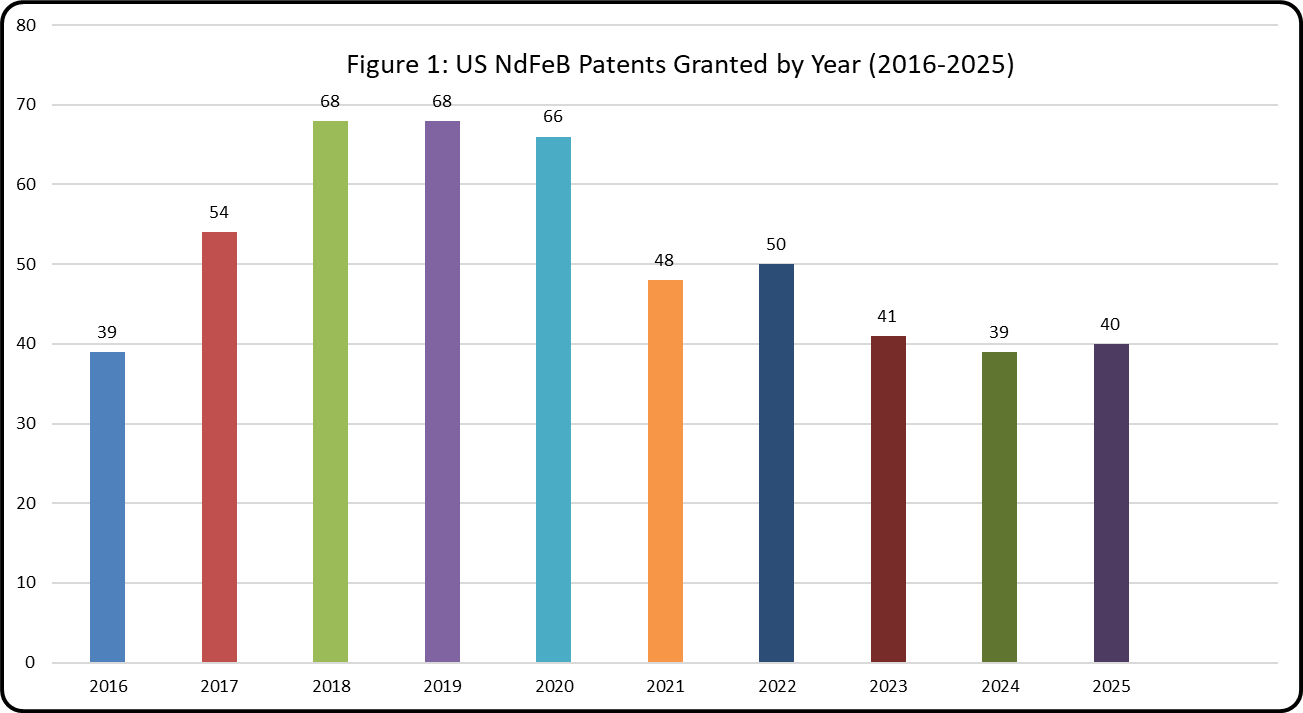
U.S. Patent grants peaked between 2018 and 2020, reaching approximately 67 patents per year, before declining to around 44 per year in subsequent years (Figure 1).
Patent Ownership
The top 10 U.S. patent owners/assignees are shown in Figure 2. It was somewhat surprising to see TDK as the number one patent holder. However, it was no surprise to see Proterial/Hitachi ranked second with 61 patents.
Notably, the major Japanese sintered NdFeB producers occupy the top three positions, accounting for roughly 40% of all US NdFeB patents granted in the past decade. This represents a significant intellectual property barrier established by these Japanese companies.
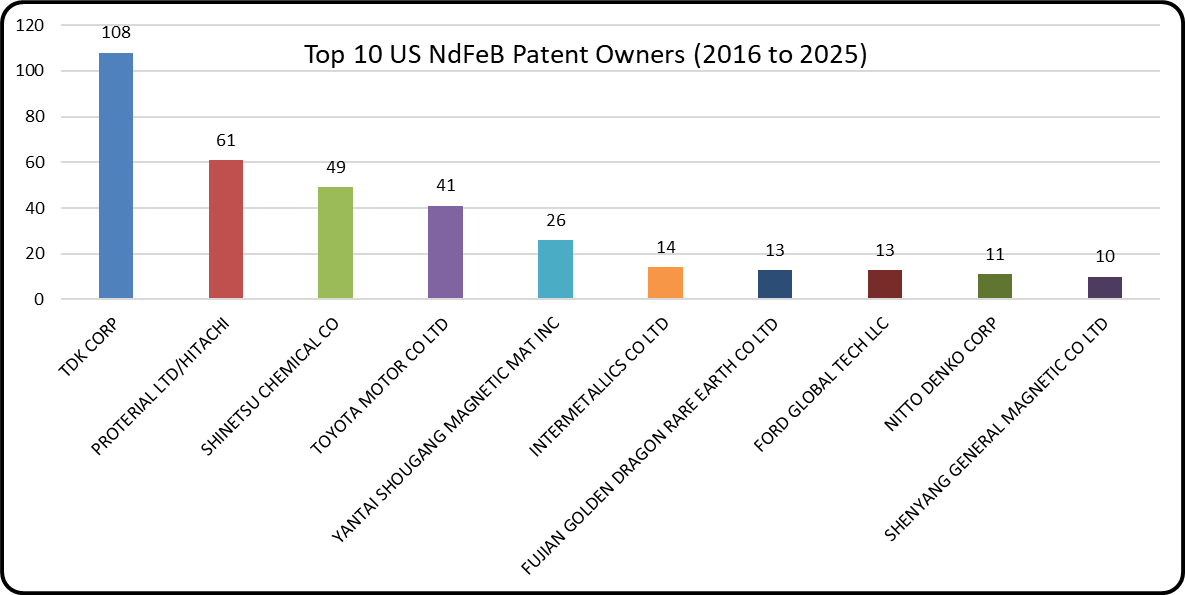
In addition, Masato Sagawa (Intermetallics) and Toyota appear in the top 10, pushing Japanese IP ownership to over 50%. Three Chinese manufacturers are also represented among the top 10 U.S. patent owners.
Technology Areas Covered
The main NdFeB technology areas covered by these patents are shown in Figure 3. As expected, grain boundary diffusion (GBD) features prominently. However, given more than 40 years of work on corrosion protection and durability improvements, it was somewhat surprising to see corrosion-related patents so heavily represented.
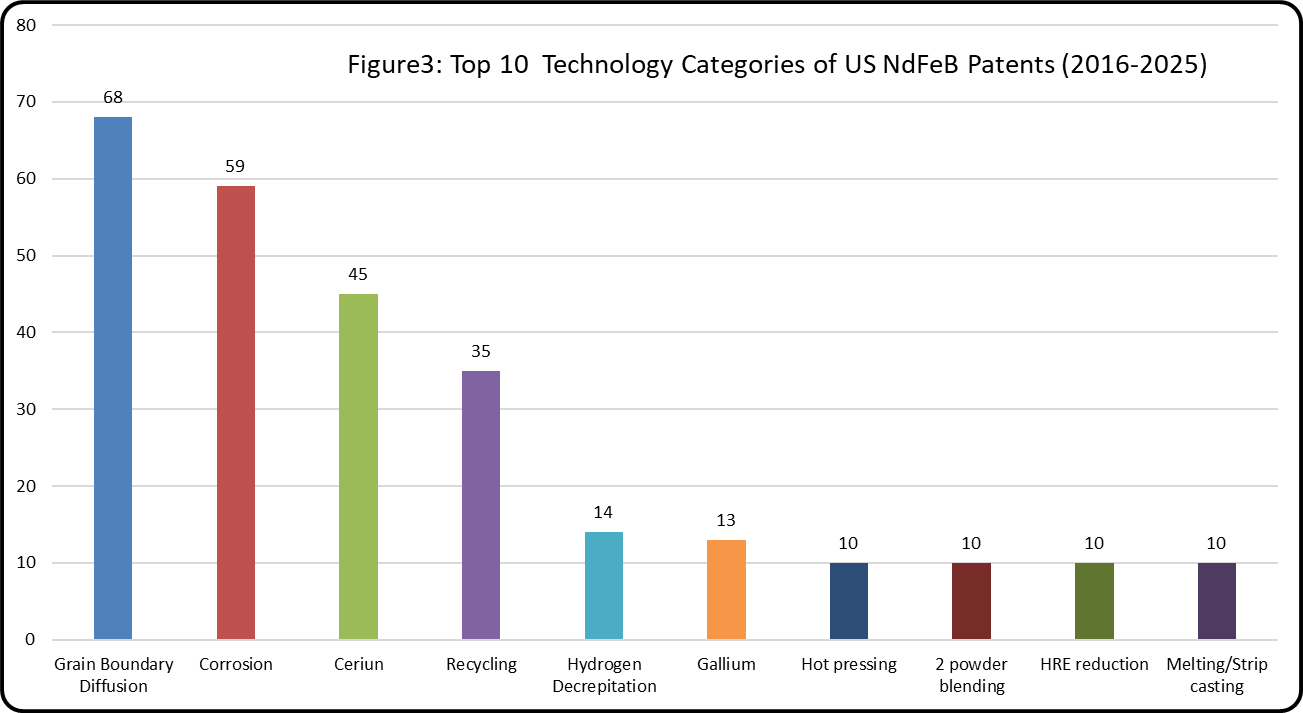
Recycling and cerium substitution also appeared frequently. While zero heavy rare earth (HRE) technologies were less prevalent, this is likely explained by the fact that work in this area has only accelerated in recent years. One should therefore expect more patents in this category to issue in the near future.
What Is Likely to Happen in the U.S.?
Some thoughts on potential future developments:
Nothing happens The fundamental NdFeB technology is well documented, with extensive overlapping IP. Patent litigation is slow, expensive, and uncertain. Several companies appear to be building patent portfolios primarily for defensive purposes.
Limited action around GBD technologies This seems less likely today than it did a few years ago, given the large number of patents already granted in this space.
HRE-free technologies This is becoming increasingly critical due to HRE scarcity and may be the one area where litigation risk could emerge.
Government intervention or influence The U.S. government has invested in—and taken equity positions in—several NdFeB magnet-related companies. Rare earth magnets are now considered strategically important for national defense. The question remains: would the U.S. government stand by if a foreign entity attempted to litigate aggressively against a domestic NdFeB producer?
U.S. Producers and Patent Activity
Among current and announced U.S. NdFeB producers, only Vacuumschmelze and Noveon appear as applicants or owners in the patent and application databases. I found no records for MP Materials, USA Rare Earth, or Vulcan Elements. It is possible that applications have been filed under different entities or have not yet been published—or they believe that scenarios (1) and (4) above are the most likely outcomes.
Final Thoughts
If anyone tells you they know exactly what will happen in the NdFeB magnet patent space over the next two years, be very skeptical. Patent litigation is costly for all parties involved. Likewise, if someone assures you that your company will never be a respondent in future IP litigation, proceed with caution.
Anyone who has participated in patent infringement or validity disputes understands the excruciating process of claim construction (or more aptly claim deconstruction). Claim construction is the court’s process of defining the exact meaning of patent claim words, so everyone understands precisely what the patent does—and does not—cover. This involves a combination of a deep understanding of patent law (hence, patent attorneys) and expert witnesses interpreting the claims as a "person of ordinary skill in the — itself is a concept hard to get your head around. In many cases, that process alone effectively decides the outcome. But no guarantees which party or when they will prevail.
JOC LLC is a leading provider of consulting services specializing in rare earth magnets. Leveraging the unparalleled expertise of Dr. John Ormerod, a renowned authority in the field of magnetics, we offer a comprehensive suite of solutions to address the unique challenges faced by companies across the rare earth magnet industry.
Dr. John Ormerod is a globally recognized expert in the field of magnetics. He has authored numerous groundbreaking publications and is a frequent speaker at leading industry conferences. His deep understanding of rare earth magnet technology and the broader magnetics industry makes him an invaluable asset to clients seeking innovative solutions and strategic advantages.
Find the original article here: https://www.linkedin.com/pulse/us-ndfeb-patents-time-bomb-who-cares-john-ormerod-cgtve/
