
The Global Rare Earth Supply Chain: Why It Matters More Than Ever
08.19.2026
By Thomas & Skinner Staff
How Geopolitical Shifts Are Reshaping the Future of Magnetic Materials and American Manufacturing
Every time an F-35 fighter takes flight, an electric vehicle accelerates onto the highway, or a surgical robot performs a flawless, lifesaving procedure, one common technology is working behind the scenes: high-performance permanent magnets. These advanced magnetic materials have become indispensable to modern society. From renewable energy systems and industrial automation to defense technologies and aerospace applications, permanent magnets enable many of today's most sophisticated innovations.
Despite these growing advancements for our world, the supply chains supporting these materials have become increasingly vulnerable to geopolitical tensions, concentrated global production, and shifting trade policies, according to the United States Magnetic Materials Association (USMMA), an industry organization dedicated to advancing domestic magnetic materials manufacturing, supporting national security initiatives, and advocating for policies that strengthen America's access to critical magnetic materials. For manufacturers, engineers, and policymakers alike, understanding the rare earth supply chain is no longer simply an academic exercise but a strategic necessity.
At Thomas & Skinner, we have manufactured engineered magnetic materials in the United States for more than a century. As one of the nation's leading domestic producers of Alnico, we understand that supply chain resilience extends far beyond sourcing raw materials. It requires decades of manufacturing expertise, domestic production capacity, and a commitment to strengthening America's industrial base.
Rare Earth Magnets Power the Modern Economy
Every time you pick up your phone or reach into your pocket to check a message, you are holding a device that depends on rare earth magnets. The tiny speakers, vibration motor, camera autofocus system, and countless precision components inside modern smartphones all rely on permanent magnets made possible by rare earth elements. The same is true when you slip on a pair of wireless earbuds before a morning walk or open your laptop to begin the workday. Even the washing machine quietly running in the background and the electric vehicle charging in the garage may depend on high-performance rare earth magnets for efficient, reliable operation. These materials have become so deeply embedded in modern life that most people never think about them, yet they enable many of the technologies we rely on every day.
As our world becomes increasingly connected and automated, the importance of maintaining a secure and resilient rare earth supply chain extends far beyond manufacturing, affecting nearly every aspect of our daily lives. Although relatively small in size, permanent magnets are foundational components across nearly every advanced industry. Today, they are used in:
Electric vehicle traction motors
Wind turbine generators
Commercial aircraft
Defense systems
Medical imaging equipment
Factory automation
Consumer electronics
Robotics
Satellites
Oil and gas exploration
Semiconductor manufacturing
Many of these technologies rely on rare earth magnets, particularly Neodymium-Iron-Boron (NdFeB) and Samarium Cobalt (SmCo) magnets because of their exceptional magnetic strength and efficiency. The challenge is not that rare earth elements are geologically rare. Rather, the complex supply chain required to transform mined ore into finished magnetic materials has become highly concentrated geographically.
What Are Rare Earth Elements?
Rare earth elements (REEs) comprise 17 metallic elements, which include the 15 lanthanides along with scandium and yttrium. The main economic sources of these elements are bastnasite, monazite, loparite, and lateritic ion-adsorption clays. The crustal abundance of these metals varies significantly, with cerium being the most abundant at 60 parts per million. At the same time, thulium and lutetium are much rarer, each at approximately 0.5 parts per million. These metals, which typically exhibit an iron gray to silvery luster, are generally soft, malleable, and ductile. Their notable reactivity, especially at elevated temperatures or in finely divided forms, enhances their value for a range of applications. Several of these elements play critical roles in manufacturing high-performance permanent magnets, including:
Neodymium (Nd)
Praseodymium (Pr)
Dysprosium (Dy)
Terbium (Tb)
Samarium (Sm)
Unlike many industrial metals, producing usable rare earth materials involves multiple highly specialized processing stages. The typical supply chain has many phases, including exploration, mining, separation, refining, alloy manufacturing, magnet manufacturing, and component integration.
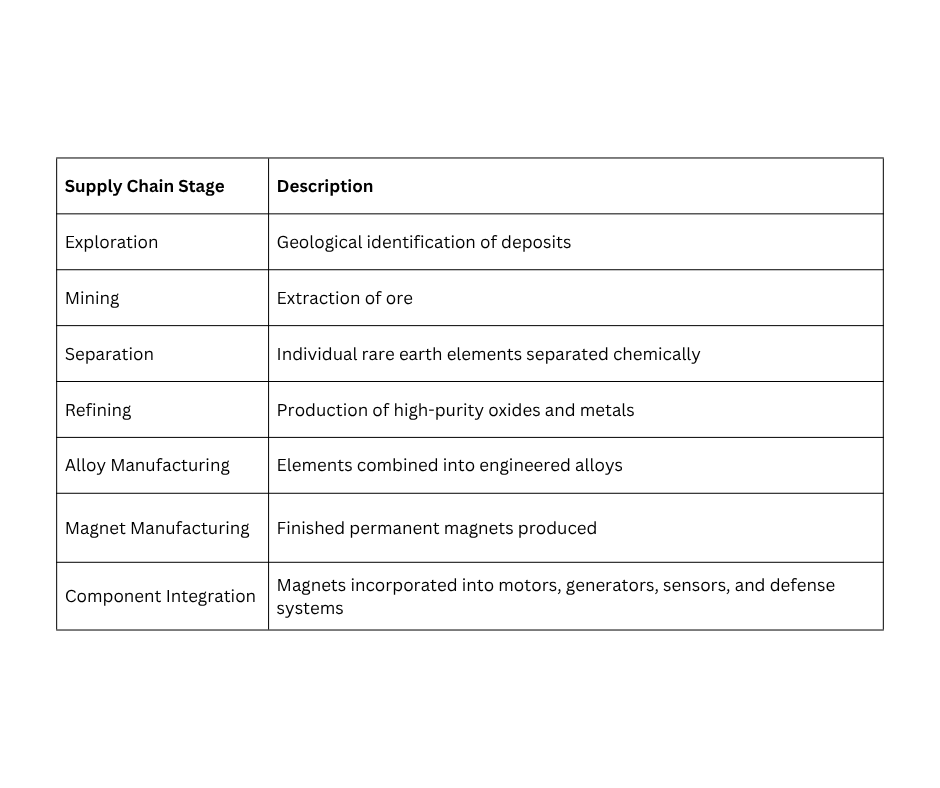
Each stage requires unique expertise, significant capital investment, and sophisticated processing technology. As the United States Geological Survey (USGS) has noted repeatedly in its annual Mineral Commodity Summaries, the greatest vulnerability is not necessarily mining capacity but the concentration of downstream processing and refining capabilities.
A Supply Chain Concentrated in One Region
One of the defining characteristics of today's rare earth market is geographic concentration.
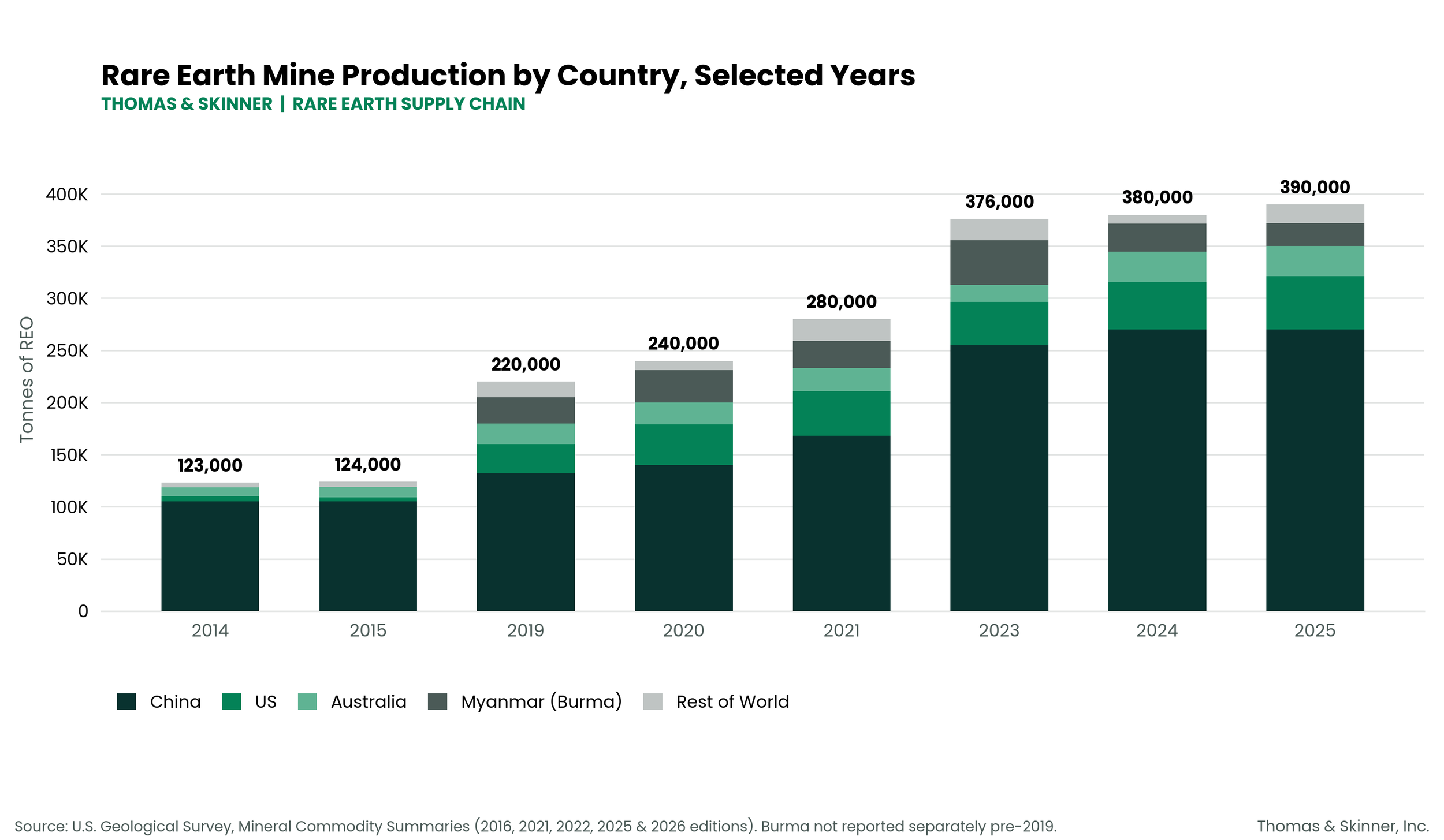
According to the latest USGS Mineral Commodity Summaries, China remains the world's largest producer of rare earth materials while also maintaining an overwhelming share of global refining and magnet manufacturing capacity. Although other countries, including Australia, the United States, Myanmar, Thailand, and several African nations, have expanded mining operations, downstream processing remains heavily concentrated within China.
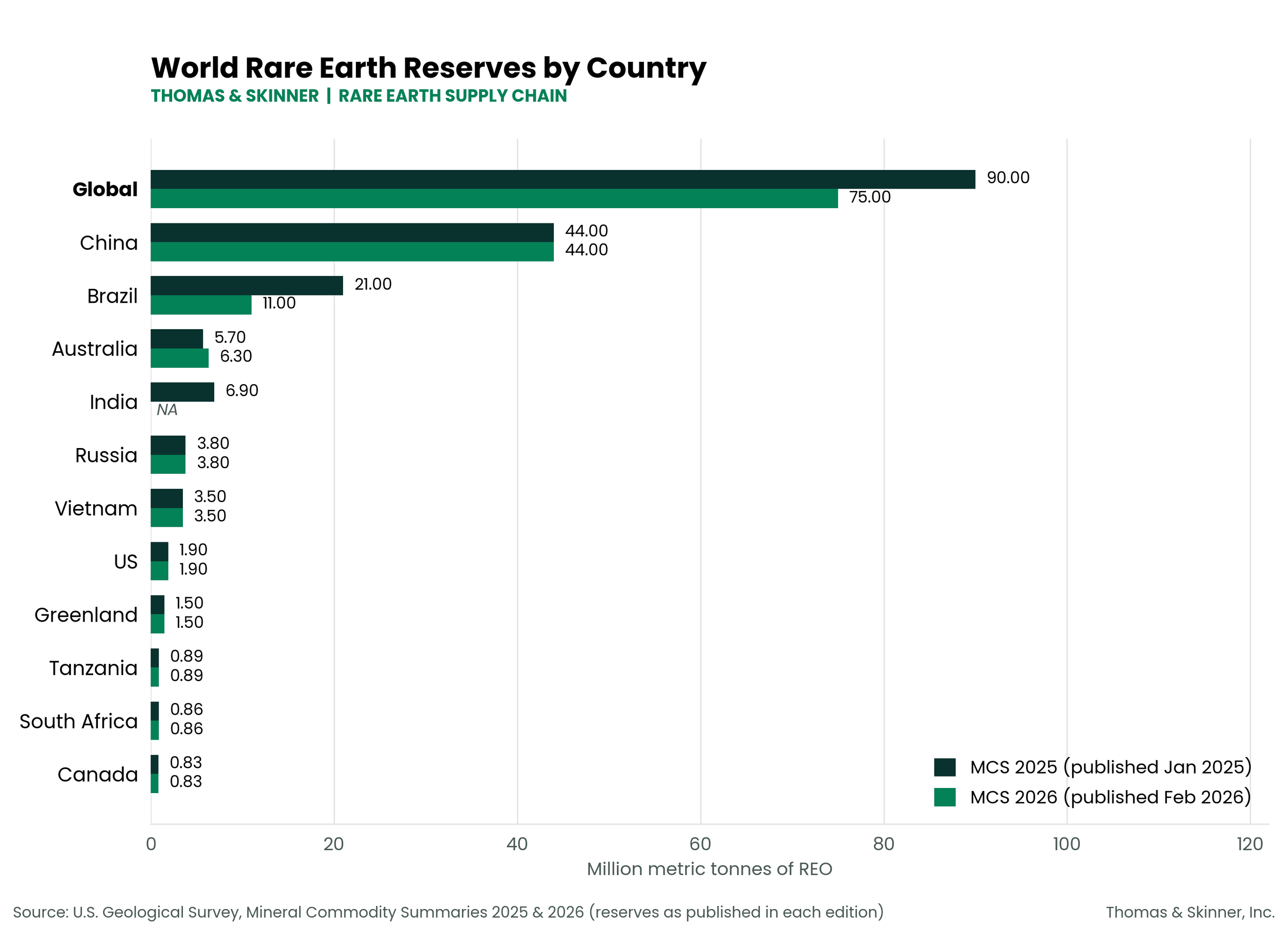
Even the "known" side of the rare earth supply chain is less stable than it appears. Comparing the USGS’s two most recent Mineral Commodity Summaries reveals two notable revisions: Brazil's estimated reserves were cut nearly in half, from 21 million to 11 million metric tons, and India's reserve figure was removed entirely, downgraded to "not available" rather than carried forward at its previous 6.9 million ton estimate. These aren't just rounding adjustments; they're a reminder that reserve data itself is a moving target, shaped by incomplete surveys, shifting government reporting, and gaps in verified geological data. For companies sourcing rare earth materials, that uncertainty is a supply chain risk in its own right, on top of the concentration risk posed by China's dominant reserve and production position.
This concentration risk creates several strategic risks:
Export restrictions can rapidly affect global availability.
Geopolitical conflicts may disrupt critical supply chains.
Manufacturers face increased price volatility.
Defense contractors experience procurement uncertainty.
Advanced manufacturing projects become more difficult to plan over the long term.
These challenges extend well beyond commercial manufacturing. Rare earth supply chain resilience has become a strategic priority for national defense, energy security, and technological leadership.
Why Supply Chain Resilience Matters
Recent geopolitical events have demonstrated how quickly global supply chains can change.
Trade restrictions, export licensing requirements, and increasing competition for critical minerals have prompted governments worldwide to reevaluate dependence on foreign sources for essential materials.
Building resilience in the rare earth supply chain matters because it supports technologies that most people rely on every day, often without realizing it. Beyond consumer products, these materials are indispensable to industries that drive the global economy, including aerospace, defense, automotive manufacturing, renewable energy, robotics, medical technology, and semiconductor production. The U.S. Geological Survey (USGS) continues to identify rare earth elements as strategically important because demand is accelerating while global production and, more significantly, processing capacity remain highly concentrated.
As electrification, artificial intelligence, advanced manufacturing, and defense modernization continue to increase demand, the challenge extends beyond securing enough raw materials; it is about ensuring reliable access to every stage of the supply chain, from mining and refining to alloy production and permanent magnet manufacturing.
How Governments and Companies are Investing in Strategies and Solutions for Supply Chain Resilience
The efforts to enhance the resilience of the U.S. mine-to-magnet ecosystem have gained significant momentum, aimed at supporting domestic manufacturing and minimizing strategic vulnerabilities. Advocacy is crucial to advancing these efforts, and organizations like the United States Magnetic Materials Association (USMMA) are supporting them through education, policy, and collaboration among industry leaders.
Securing a more reliable rare earth supply chain necessitates a multifaceted approach that extends beyond simply opening new mines. Governments and industry stakeholders are now investing throughout the entire mine-to-magnet value chain. This includes expanding domestic mining, building facilities for rare earth separation and refining, increasing capacity for alloy and permanent magnet manufacturing, and developing recycling technologies. Furthermore, strategic partnerships with allied nations, along with the establishment of stockpiles for critical materials, are underway. Federal agencies are also implementing policies to diversify the supply chain, reduce dependence on foreign adversaries, and accelerate investment in domestic critical mineral production.
For manufacturers like Thomas & Skinner, these initiatives align with a long-standing commitment to producing critical magnetic materials domestically, helping support customers in defense, aerospace, industrial, and energy markets.
Find the original article here: https://www.thomas-skinner.com/the-global-rare-earth-supply-chain-why-it-matters-more-than-ever/
